Monday, June 23, 2025
Paganini - Violin Concerto No. 3 In E Major
Sunday, June 15, 2025
Alkan - Symphony For Piano Solo
The coda moves towards a C major chord, but the chord changes to C minor to end the movement. Alkan stayed true to the form of the first movement of a symphony, almost classical in proportion, but included passion and changes of mood along the way.
II. Marche Funèbre - Andantino - The first edition of the etudes had the following on the title page: Marcia funebre sulla morte d’un Uomo da bene (Funeral march on the death of a good man). No one knows to whom Alkan was referring to. Some think it might have been his father who had died two years before.
The theme is played legato over a staccato accompaniment. The movement is in F minor following the key scheme of the set of 12 as it is in a perfect 4th from the preceding movement. the middle section is more lyrical for contrast, and the march resumes. Before the end, a drum roll deep in the bass interrupts the march. A short coda reaches a climax before the music dies away and ends in F major.
III. Menuet - Hardly a menuet as known by Haydn and Mozart, this is a hectic scherzo in B-flat minor.
The energy of the scherzo dissolves into a lyrical trio that is in contrast. The scherzo returns and leads up to a short return of the trio until it ends in B-flat major.
IV. Finale - Presto - The most technically challenging movements of the symphony. It is in E-flat minor, but modulates in and out of the home key.
The pace does not let up, even if the minor mood of the music changes to major. Breathlessly, it continues to run (with a few delicious dissonances on the way) until it finally runs itself out and ends with E-flat octaves in each hand.
Saturday, May 24, 2025
Rossini - Bassoon Concerto
The story goes that Rossini had written the work for Nazareno Gatti, a bassoon student, for his final examination. Rossini was an advisor at the music school in Bologna where Gatti attended, but scholars aren't sure how much Rossini was involved with writing the concerto. He may have sketched it out for someone else to finish, as he did with many of his compositions during his retirement. Some say Gatti finished it, or Gatti may have wrote the entire work and put Rossini's name to it. In any event, scholars agree it was written in the 1840's and in the style of Rossini. If it truly was written by Rossini, it would represent his final work for orchestra, as the aforementioned Péchés de vieillesse were chamber works or solo piano.
I. Allegro - The work opens in the key of B-flat major with the orchestra stating the themes of the movement as per usual in a concerto, especially this movement that is built more in Classical era form and techniques than Romantic. The bassoon enters and plays the first theme along with punctuations of the low registers of the instrument. The orchestra begins the second theme with light pizzicato violins. The clarinets play along with the soloist and the music goes into the development section. The soloist gets a chance to show off the instrument and after the recapitulation a short coda allows the bassoon to reach the heights and depths of its range as the music comes to a close.
II. Largo - The music shifts from B-flat major to C minor, a key quite distant from B-flat major. In this lyrical movement the bassoon sings as if it is a soloist in a scene from an opera. The tonal range of the movement showcases the bassoons unique timbre changes in its registers. The movement ends with dramatic tremoloes in the strings as the music fades away.
III. Rondo - The plethora of notes for the soloist doesn't let up in the finale, nor their extreme ranges. The music is in the key of F major, something different than many concertos of this time as it isn't in the same key of the first movement. The title page of the manuscript states that it is a Concerto da Esperimento , or an Examination Concerto. The music truly is a test for the soloists technical and musical abilities. The question of its authorship not withstanding, this concerto is a fine representation of what the bassoon can do in the hands of a virtuoso, and is a valuable addition to the repertoire.
<Sunday, March 23, 2025
Woods - Slippery Elm Rag
The affinity for ragtime grew until Scott Joplin had his biggest hit of all, his 1897 Maple Leaf Rag. It was Joplin who insisted that despite the roots of ragtime, it had become a classical form and should be treated and played as such. This lead to Joplin admonishing potential players right on the sheet music - "Don't play this piece fast. It is never right to play ragtime fast." This was also part of the rehabilitation of ragtime, as black ragtime piano players would have competitions against one another to see who could come up with the best ideas, and who could play the fastest. Of course tempo is a relative thing, and the tempo of a ragtime piece can be pushed to a certain extent, if the character of the piece calls for it. But the slap-dash, break neck speed that ragtime's been subjected to by some is what Joplin was against.
Clarence Woods was born in 1888, raised in Eastern Kansas, and Carthage, Missouri right in the middleof Ragtime country when he was learning how to play the piano. He left home early on, and began traveling with vaudeville shows and stock companies as an accompanist. He also started working as a silent movie accompanist as well. In 1907 he was performing in the Fort Worth, Texas area and wrote some of his early ragtime pieces there. His first folk rag was Slippery Elm, written in 1912. He continued to write ragtime as well as early blues pieces. He was married and divorced, continued to work as a professional musician. During the Depression, his livelihood was hit hard like many musicians, and when he lived in Tulsa, Oklahoma, he was an organist at a local skating rink.Opportunities increased after WW II, as he lead an orchestra, became a local radio personality, and began composing more. His last compositions were never published, and much of his compositions and arrangements were for concert band. He also worked for a time as a composer/arranger for Ringling Bros. Barnum And Bailey Circus, as well as performing on the organ and steam calliope. He passed away in 1956 while visiting his son in Davenport, Iowa.
Slippery Elm is an instance where a composer took Joplin's advice about playing fast seriously. Woods tempo indication is 'Very Slow', and when it is heeded, the piece can remind the listener of a Chopin Nocturne. Slow and easy, a little bit of drama with a touch of melancholy. Good ragtime is indeed classical in nature, and shows that it graduated from its roots of bordello and tavern hectic qualities to bitter sweet music. And in many ways, when ragtime is played slowly, it has a whole other set of difficulties in performing it. A steady, clear underlying beat that will naturally accentuate the syncopations, and a rounding off of the edges into a smooth, meditative style of music.
The name Slippery Elm also fits the music quite well. The inner bark (sometimes leaves) of the Slippery Elm was used by Native Americans and in folk medicine for the treatment of skin rashes, upset stomach, colon issues, sore throats, and other uses. The inner bark releases a gelatinous substance that is used for many kinds of inflammation. There is scant evidence as to the efficacy of its use, but some people still use it. It was said to soothe and comfort inflamed tissues, as the music of this rag gives soothing comfort to the ear.Friday, January 31, 2025
Haydn - Symphony No. 88 In G Major Hob. I/88
He worked as Kappellmeister for the Esterházy family of Hungary, and all of the music Haydn composed up until 1779 was the property of his employer. But with the renegotiation of his contract in 1779, he was allowed to take outside commissions and sell to publishers.
Symphony No. 88 was the first written after his Paris Symphonies in 1787, and has become one of his favorites, despite not having a nickname or being included in a set. Haydn did allow a violinist that played in the Esterházy orchestra, Johann Tost, to take it along with Symphony No. 89 to Paris to try and sell them, which he did.
The Symphony is in four movements:
Saturday, November 16, 2024
Haydn - Motet 'Insanae et vanae curae'
often mad fury fills the heart, robbed of hope,
O mortal man, what good does it to strive for worldly things,
if you neglect the heavens?
All things work in your favor, with God on your side.
Thursday, October 31, 2024
Ives - Variations On 'America'
![]() |
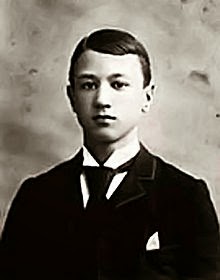
| Charles Ives, 1889 |
Ives' music won the support of a young Leonard Bernstein who conducted Ives' Second Symphony on a live radio broadcast in 1951. Arnold Schoenberg, the great composer and teacher knew of Ives and after Schoenberg died in 1951 (three years before Ives), Schoenberg's widow found a note written by her husband in his desk that had been written in 1944:
There is a great Man living in this Country – a composer. He has solved the problem how to preserve one's self-esteem and to learn. He responds to negligence by contempt. He is not forced to accept praise or blame. His name is Ives.One of his earliest pieces was Variations On 'America', written for organ in 1891 when Ives was 17 years old. It was written for a Fourth Of July celebration and the music shows how much his father had influenced the young man. The tune is also known as 'God Save The King' in Great Britain.
Introduction and theme- The work begins with an introduction to the tune that fragmentarily suggests parts of the tune itself. The tune is finally heard in a straight forward arrangement for the organ.
1st Variation - The tune is repeated over a running sixteenth note accompaniment in the first section, and an even more florid accompaniment of 32nd notes in the second section.
2nd. Variation - The pace changes slightly, along with the rhythm of the tune. At the end of the first section there is a descending figure of chromatic chords that gives the impression of a chuckle. The second section has subtle harmonic changes.
Interlude - A fragmentary rendition of the tune that Ives evidently didn't find worthy enough to call a variation, this interlude has one hand playing in the key of F major (the home key of the piece thus far) while the other hand and pedals play in D-flat major, an early example of bitonality.
3rd Variation - Ives gives a sprightly rendition of the tune, like music perhaps heard on a merry-go-round, all in the key of D-flat major.
4th Variation - Ives shifts gears and throws this variation in the key of F minor. He labels this variation a Polonaise, but it sounds like spirited Spanish dance to me.
Interlude - This time Ives has one hand play in A-flat major while the other hand and pedals play in F major.
5th Variation - Marked Allegro - as fast as the pedals can go, the pedals have the main variant. The tune continues in elaborate dress that shows how good Ives' organ technique must have been. The variation leads to a coda that has fragments of the theme tossed off in full volume, along with pauses for good measure. The music gets more hectic until a full throated repeat of the tune ends the work.